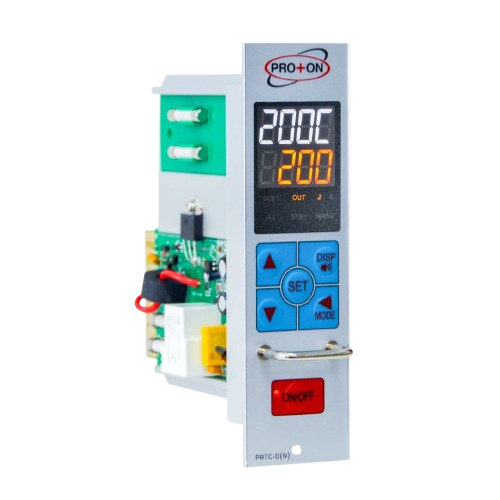
At Pragati Enterprises, we understand that in modern manufacturing, precision is everything. Whether you are running an injection molding machine, a hot runner system, or an extrusion line, maintaining accurate temperature is critical for product quality, cycle time reduction, and energy efficiency.
An industrial temperature controller automates this process. It reads the temperature from a sensor (thermocouple or RTD), compares it to your desired setpoint, and adjusts the heater or cooler accordingly.
As a trusted name in advanced industrial automation solutions with over a decade of industry experience, Pragati Enterprises delivers high-performance, energy-efficient PRO+ON brand temperature controllers to industries across India.
In this guide, you will learn:
- How a temperature controller works
- Types of controllers (On-Off, PID, SSR)
- How to select the right one
- Common applications across 15+ industries
- Troubleshooting tips
Let us get started.
The working principle is simple. Follow these four steps:
Step 1: A sensor (thermocouple or RTD) measures the current temperature of your system.
Step 2: The sensor sends this reading to the controller.
Step 3: The controller compares the reading to your desired setpoint.
Step 4: If the temperature is too low, the controller turns on the heater. If too high, it turns on the cooler or turns off the heater.
This cycle repeats continuously, keeping your process at the exact temperature you need.
Understanding the different types helps you choose the right one for your application.
Type 1: On-Off Controller (Bang-Bang Control)
The simplest type. The output is either fully ON or fully OFF.
How it works: When temperature drops below setpoint → Heater turns ON. When temperature exceeds setpoint → Heater turns OFF.
Accuracy: ±2 to 5°C
Best for: Low-cost, non-critical applications
Limitation: Temperature constantly cycles up and down around the setpoint
Type 2: PID Controller
The most advanced and widely used type for industrial applications. PID stands for Proportional-Integral-Derivative.
How it works: The controller calculates exactly how much power to send to the heater based on three factors:
- Proportional (P): Responds to the current temperature error
- Integral (I): Eliminates any long-term offset
- Derivative (D): Anticipates future temperature changes
Accuracy: ±0.1°C
Best for: Injection molding, hot runners, extrusion, precision work
Advantages: No offset, fast response, auto-tune available
Type 3: SSR Output Controller
This is a variation where the controller sends a DC voltage signal to drive a Solid State Relay (SSR).
How it works: Controller sends 12V or 24V DC signal → SSR switches the heater load silently
Accuracy: ±0.1°C
Best for: High-frequency switching, silent operation
Advantages: No moving parts, infinite lifespan, completely silent